Instrument Guides
What Is the Guqin? A Beginner's Guide to China's Seven-String Zither
A plain-language introduction to the guqin: what it is, how it makes sound, the roles of open strings, stopped strings and harmonics, and its place in Chinese cultural history.
If you have heard a recording of quiet, slowly unfolding Chinese music with long silences between the notes, there is a good chance you were listening to a guqin (古琴, qín) - a seven-stringed zither that has been played in China for a very long time.
This guide answers the questions a newcomer usually has, in the order they tend to come up.
What is a guqin?
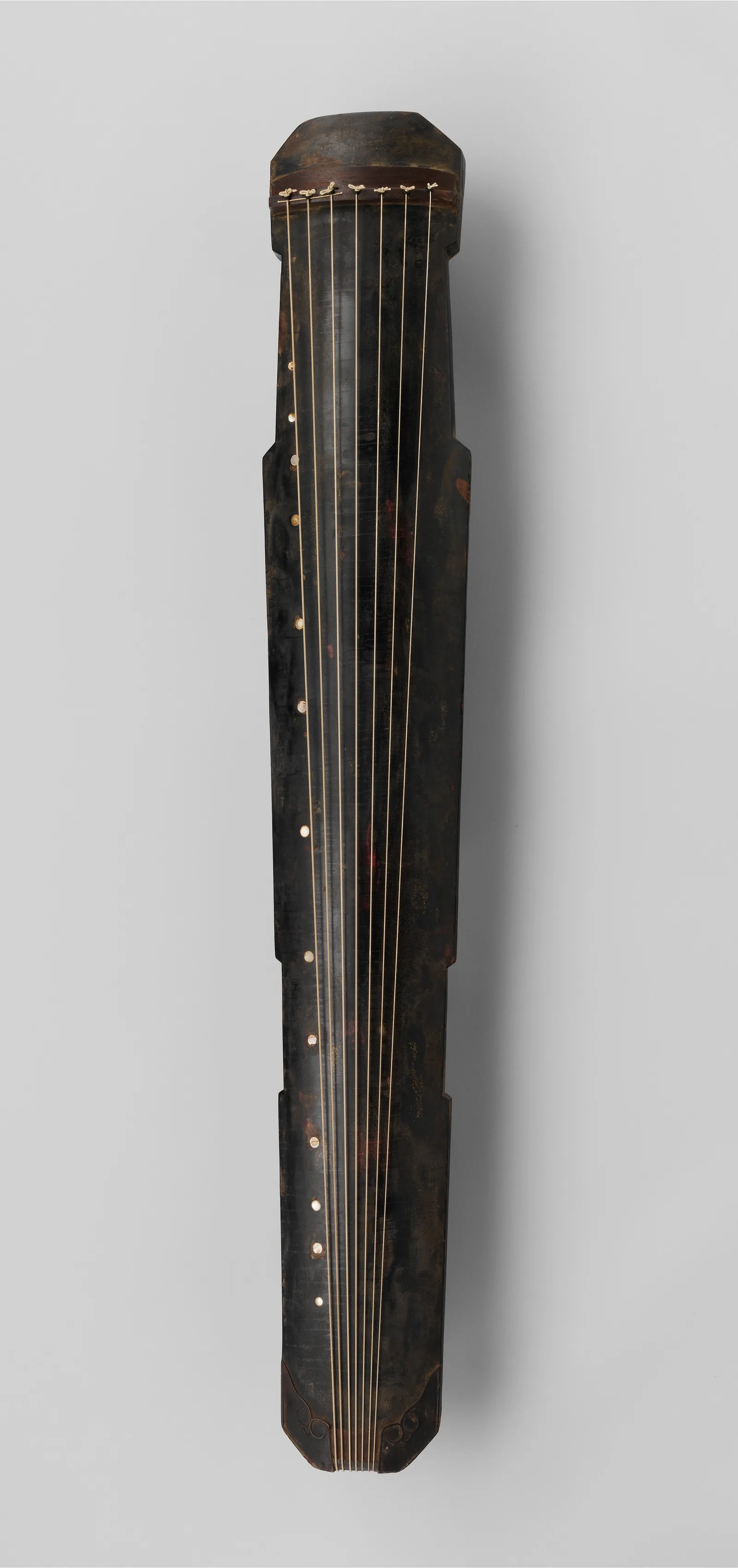
A guqin is a fretless zither with seven strings stretched over a long, shallow wooden body. The player plucks the strings with the right hand while the left hand stops them, touches them, or lets them ring open.
Two features set it apart from many instruments you may know:
- It has no frets. Nothing on the surface fixes the pitches for you, so the left hand finds them by position and by ear.
- It is quiet. The guqin is not built to fill a concert hall. Much of its music is intimate, and the space around the notes matters as much as the notes.
In older English writing the guqin is sometimes called the “Chinese lute” or simply “the qin”. Those names are historical and can be confusing, because qin on its own is now used for many instruments. “Guqin” - literally “ancient qin” - is the clearest name to use.
What does a guqin look like?
The instrument is a long, narrow board, gently curved on top, with a slightly wider head and a narrower tail. Seven strings run its full length, tuned from low to high. Small studs called hui are set into the surface along the outer edge; they mark the positions used for harmonics and for finding notes.
The instrument rests either on a low table or across the player’s lap, and is played seated. Its proportions are part of its identity: the traditional description links the instrument’s length and its parts to symbolic numbers, though such descriptions belong to a way of writing about the instrument rather than to measured engineering.
How does a guqin make sound?
Almost all guqin technique comes down to three ways of sounding a string. Each produces a different character of tone, and a single piece usually moves between all three.
Open strings - san
An open-string note (san, 散音) is played by plucking a string that the left hand does not touch. The whole string vibrates, giving the deepest and most resonant sound available on the instrument. These notes often carry the slower melodic lines.
Stopped strings - an
A stopped-string note (an, 按音) is played when the left hand presses a string down against the surface while the right hand plucks. Pressing shortens the vibrating length, so it raises the pitch - and because there are no frets, the player can slide smoothly from one pitch to another. This is where the instrument’s characteristic glides and its subtle vibrato come from.
Harmonics - fan yin
A harmonic (fan yin, 泛音) is produced by letting the left hand touch - not press - a string at a particular point while the right hand plucks. The result is a clear, high, bell-like tone.
It is worth separating two ideas here. Harmonics are a general acoustic phenomenon, found on many stringed instruments. Fan yin is the guqin’s playing practice built on that phenomenon. The two are connected, but they are not the same thing, and treating them as identical can make descriptions of the technique harder to follow.
Why is the guqin connected with Chinese cultural history?
The guqin became closely associated with the world of the Chinese scholar - the literati. In that setting it was treated less as a concert instrument than as a companion for solitary practice, poetry and self-cultivation.
That association is a real and important part of the guqin’s history. It is also a specific one: it describes a particular tradition and a particular social group, not the whole of Chinese music and not every period. Other instruments, other repertoires and other social settings existed alongside it.
In 2003 the guqin and its music were inscribed on UNESCO’s Representative List of the Intangible Cultural Heritage of Humanity, a recognition of the tradition’s continuing transmission.
What should a beginner listen for?
Try these four things on any guqin recording:
- Silence. Notice the pauses. They are part of the music, not gaps in it.
- Decay. Follow a single note as it fades. The way a note dies is as characteristic as the way it begins.
- Slides. Listen for the left hand travelling between pitches - the sound bending rather than stepping.
- Register. Notice when the music moves between the deep open-string notes and the bright harmonics.
You do not need to identify every technique to hear these. They are simply places to put your attention.
How to verify and keep learning
This article draws on institutional sources rather than on summaries:
- UNESCO’s page on Guqin and its music supports the instrument’s basic description, its three ways of sounding a string, and its heritage status.
- The Metropolitan Museum of Art’s entries for surviving guqins support the physical description of the instrument - its materials, its thirteen studs (hui), and its silk strings.
To see how the guqin sits next to other Chinese instruments, the Traditional Instrument Explorer puts the guqin, guzheng, pipa and erhu side by side, with a source behind every field.
Details such as the history of individual pieces, the lives of particular players, or contested historical claims need more specialised sources, and are not settled by these two pages alone. Where this article explains or simplifies something for a general reader, that is editorial framing rather than a claim taken directly from a source.